Voice Isolation vs Noise Reduction vs Dereverb: What Fixes Which Problem?

Voice isolation, noise reduction, and dereverb can all make a recording sound cleaner, but they solve different problems. Choosing the wrong one often makes speech thinner, metallic, or strangely hollow.
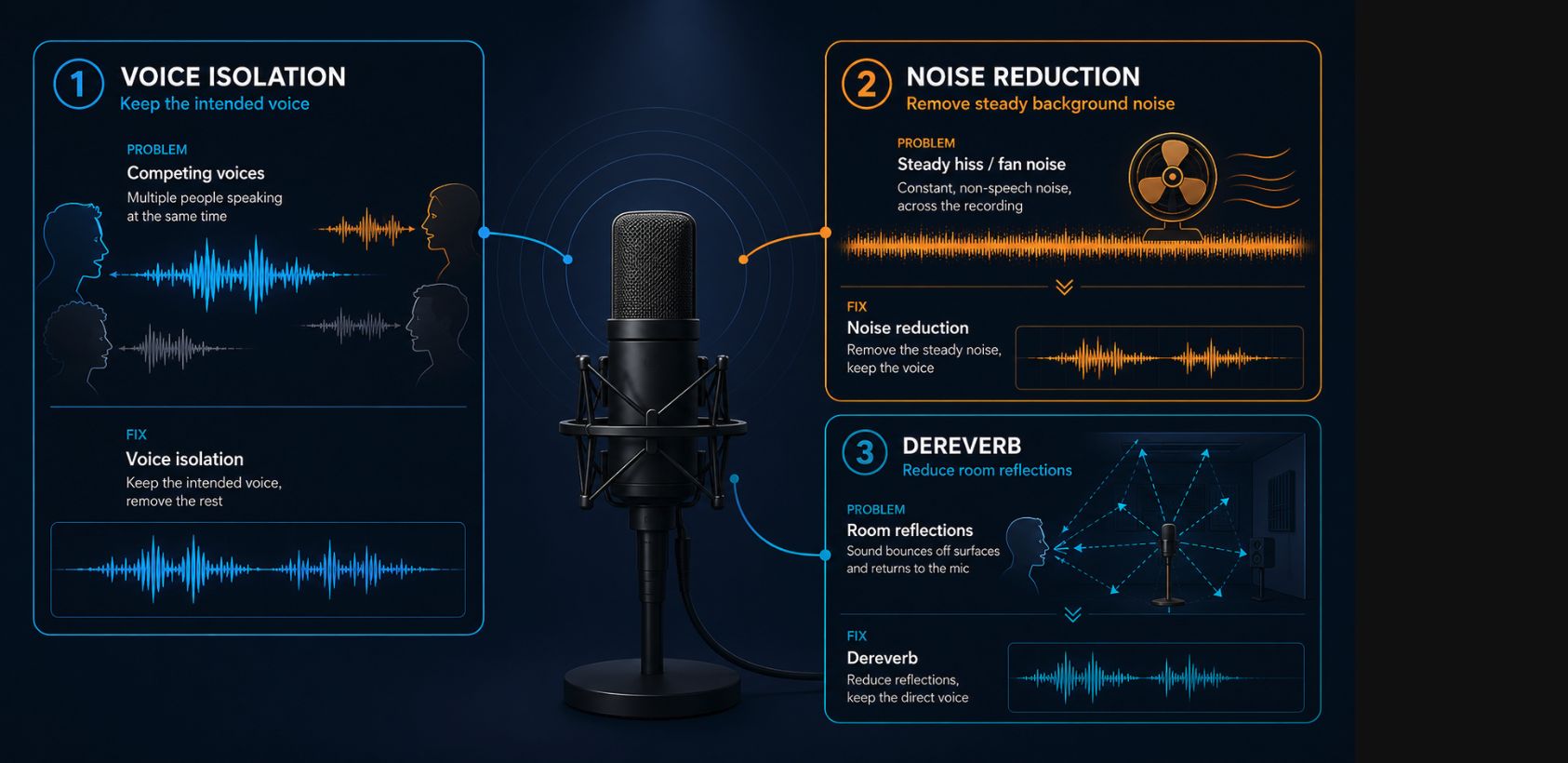
A simple rule helps: use voice isolation when another voice is competing with the speaker, noise reduction for a steady unwanted sound, and dereverb when the room itself is ringing around the voice.
Quick comparison
| Problem | Best first tool | What to listen for |
|---|---|---|
| Two people talk at once | Voice isolation | Does the main speaker become clearer without sounding underwater? |
| Fan, hiss, or traffic bed | Noise reduction | Does the steady sound fall while consonants stay natural? |
| Room reflections or echo | Dereverb | Do words stop hanging on after the speaker finishes? |
Voice isolation: for competing speech
Voice isolation is useful when the unwanted sound is another person speaking, a television in the background, or a busy conversation nearby. It tries to keep the target voice while reducing other voices and sounds.
Start with a short section where the main speaker is clear. Compare the processed version with the original. If sibilants become watery or the voice loses its low-end body, reduce the strength. A little bleed is usually better than an artificial-sounding voice.
Noise reduction: for steady sounds
Noise reduction works best on sounds that stay fairly constant: a laptop fan, air conditioner, tape hiss, or distant road noise. Many tools can learn a noise profile from a short pause where nobody is speaking.
Save an untouched copy first. Then apply the smallest amount that makes the pause quieter. Heavy reduction can create warbling or a musical background, especially around quiet words and breaths.
Dereverb: for room reflections
Dereverb targets the reflections that arrive after the direct voice. A large empty room, hard walls, and a microphone placed far away can make every sentence smear into the next one.
Use dereverb gently. Too much can remove the natural body of the voice and leave a dry, phasey texture. Listen to word endings and short pauses; those are often the easiest places to hear whether the room tail is shrinking.
Use the fixes in a sensible order
- Keep the original recording and make a working copy.
- Remove obvious competing voices with voice isolation if they are the main problem.
- Reduce steady noise with a conservative noise-reduction pass.
- Apply dereverb only if reflections are still masking words.
- Use EQ and gentle level control after cleanup, not to hide a badly overprocessed result.
Three practical examples
A second person speaks over the host
Try voice isolation first. Noise reduction will not know that the second voice is the thing you want removed.
A quiet interview has constant fan noise
Capture a small noise sample and use a light reduction pass. Dereverb will not remove a fan because the fan is not a room reflection.
A solo recording sounds like it was made in a hall
Try dereverb first, then check the pauses and consonants. Isolation and denoise may make it cleaner, but they do not fix the long reflection tail.
Check for overprocessing
Listen once on headphones and once on ordinary speakers. Watch for watery consonants, missing breaths, a metallic edge, pumping volume, or a voice that sounds detached from the room. If you hear one of these, undo the last step or lower its strength.
Bottom line
Match the tool to the problem: competing voices need isolation, steady sounds need noise reduction, and reflections need dereverb. Keeping the passes light and checking the result after each step usually sounds more natural than trying to fix everything with one aggressive setting.

Writes guides and product notes for Bytesweavers.