

Picture this: A thriving e-commerce startup scrapes 50,000 emails for a Black Friday campaign. Revenue spikes—until a single GDPR complaint triggers a fine equal to 4% of their global revenue. Suddenly, those “quick wins” become existential threats. If you think email scraping is just a technical challenge, think again.
Globally, privacy-related fines surged by 137% last year, with data scraping violations among the top triggers. With GDPR enforcement expanding beyond the EU and CCPA penalties reaching $7,500 per intentional violation, this isn’t about compliance—it’s survival. Here’s how to harvest business-critical email data without becoming a cautionary tale.
GDPR vs. CCPA: The Hidden Traps in Your Scraper Code

Most developers build scrapers to handle CAPTCHAs and IP rotation—not Article 6 compliance. GDPR requires lawful basis for processing EU residents’ data, while CCPA demands explicit disclosure before collecting Californians’ information. Here’s where teams get blindsided:
- B2B isn’t a free pass: CCPA exempts business contact info only if sourced from public records. Scraped LinkedIn emails? Not covered
- Consent vs. Legitimate Interest: GDPR allows email processing without consent for legitimate business interests—but you must prove balance between your needs and individual privacy rights
- The 72-Hour Rule: Both regulations mandate breach notifications within three days of discovering scraped data leaks
A marketing agency recently faced a €200,000 fine for assuming “publicly available” meant “fair game”—their scraper collected personal emails from EU forum profiles without assessing lawful basis.
3 Technical Safeguards for Ethical Scraping
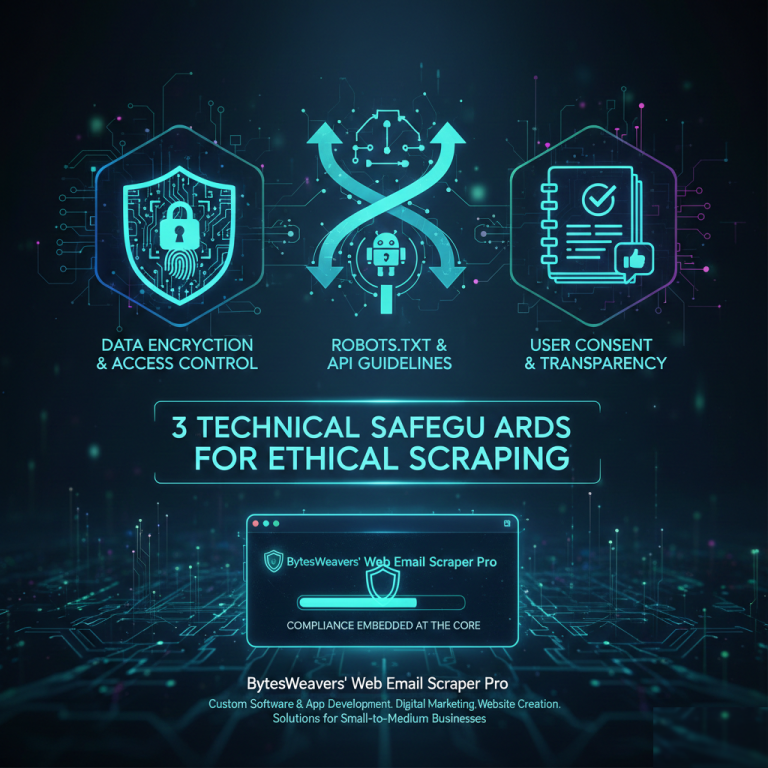
Modern tools like BytesWeavers’ Web Email Scraper Pro embed compliance at the infrastructure level. Here’s how to architect your scraping pipeline:
- Geo-Fencing Logic: Automatically exclude domains from .eu, .fr, or .it TLDs when lacking documented lawful basis. For CCPA, screen for California business registrations
- Data Minimization by Design: Configure scrapers to only capture emails matching
.*@business-domain.compatterns—avoid personal Gmail/Outlook addresses that increase legal exposure - Real-Time Consent Watermarking: Tag each scraped email with source URL, timestamp, and consent context (e.g., “User listed email in public ‘Contact Us’ page with implied consent”)
Encoding these rules shifts compliance from a manual legal review bottleneck to an automated fail-safe. As one logistics firm discovered, rebuilding their scraper with these guardrails reduced GDPR-related support tickets by 83%.
The Post-Scraping Protocol 92% of Businesses Ignore
Scraping is just step one. GDPR Article 30 demands ongoing Record of Processing Activities (RoPA)—a living document tracking how you use scraped data. Every email campaign must be cross-referenced against:
- Retention Schedules: Automatically delete records exceeding 13 months (standard for prospecting data)
- Opt-Out Chains: Update scraped datasets within 24 hours of unsubscribe requests—CCPA requires honoring opt-outs within 15 days
- Third-Party Audits: Use API-based tools to prove to regulators that your Mailchimp/Salesforce integrations scrub deleted emails
When French authorities audited a SaaS company’s RoPA logs last year, they found 14,316 emails retained 278 days past expiration—resulting in a per-record fine structure that multiplied penalties 47x beyond base offenses.
Turning Compliance into Competitive Advantage
Privacy isn’t just about avoiding fines—it’s trust engineering. 68% of B2B buyers will abandon brands after a single privacy mishap. By baking GDPR/CCPA compliance into your scraping workflows, you signal operational integrity that converts better.
Start by pressure-testing your current tools: Can your scraper auto-generate Data Protection Impact Assessments? Does it log processing purposes for every harvested email? If not, you’re playing regulatory roulette.
Your next campaign deserves more than just high open rates—it deserves bulletproof legal grounding. Because in 2026, the most valuable email isn’t the one that converts—it’s the one that won’t bankrupt you.
