
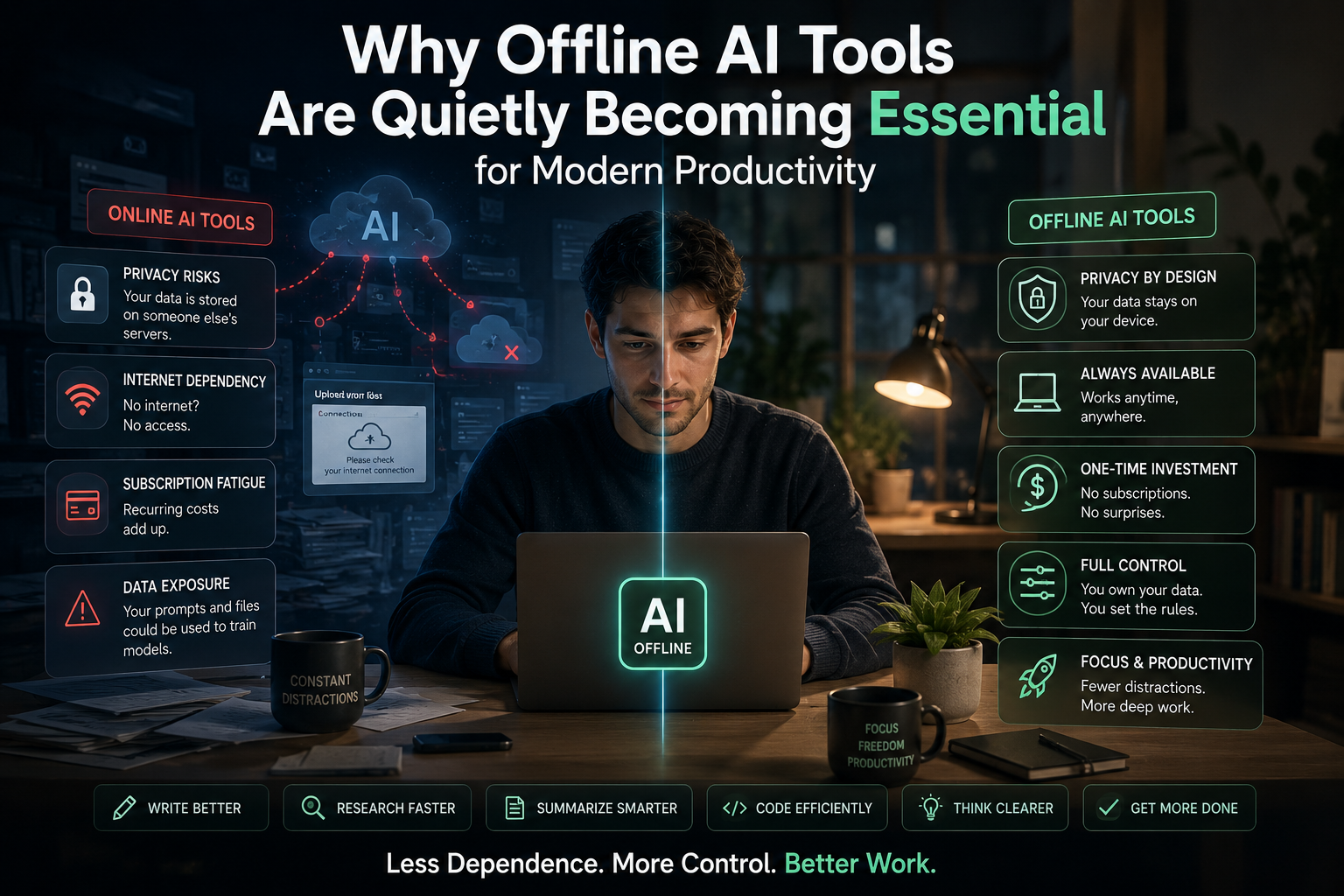
For the last few years, most people accepted cloud-based AI as the default. You opened a browser, uploaded your files, waited a few seconds, and got results. It felt convenient enough that very few users stopped to think about what was happening behind the scenes.
That has started changing.
More professionals are now questioning where their data goes, how much control they actually have, and whether constant cloud dependency is creating more friction than convenience. This shift is happening slowly, but it is visible almost everywhere now. Designers are becoming more cautious with client files. Developers are looking for local workflows. Remote workers are trying to reduce digital overload. Small businesses are actively cutting recurring software costs.
At the same time, local hardware has become powerful enough to run tasks that previously required expensive cloud infrastructure.That combination is pushing a major transition inside the software industry:
offline AI tools are moving from niche utilities into practical everyday workflows.
The interesting part is that most users are not switching because of hype. They are switching because of fatigue, privacy concerns, workflow interruptions, and rising operational costs.
Why Cloud-Based AI Workflows Start Feeling Heavy Over Time

Most online AI tools work well during short-term experimentation. The problems usually appear after AI becomes part of someone’s daily routine.
This is where many professionals start noticing hidden friction.
A designer uploading dozens of large image files every day eventually starts caring about processing delays and file exposure. A remote employee handling sensitive documents becomes uncomfortable relying entirely on third-party servers. Teams juggling multiple subscriptions suddenly realize they are spending more on AI tools than they expected six months earlier.
None of these problems appear dramatic individually. Together, they slowly wear down workflow efficiency.
This is one reason searches related to local processing, privacy-first software, and offline AI tools have increased significantly across productivity-focused communities.
The demand is no longer coming only from technical users. Ordinary professionals are beginning to care about:
- data ownership
- local processing
- software reliability
- subscription reduction
- workflow stability
That changes the entire direction of the market.
Privacy Concerns Are No Longer Paranoia

A few years ago, discussions around AI privacy were often dismissed as overreactions. That attitude has changed considerably.
Businesses now understand that employees regularly upload:
- contracts
- financial records
- customer information
- internal presentations
- legal documents
- proprietary designs
into online systems.
Even when platforms have strong security policies, many organizations are uncomfortable with sensitive operational data leaving internal environments altogether.
The issue becomes more serious in industries with regulatory obligations. Healthcare, finance, legal services, and consulting firms increasingly evaluate whether cloud-based processing creates unnecessary exposure risks.
The broader concern is not always about data theft directly. In many cases, it is uncertainty.
People simply do not know:
- how long files are stored
- whether uploaded data contributes to training
- what happens after deletion
- how third-party integrations handle information
That uncertainty alone is enough to push users toward local alternatives.
The Mozilla Foundation has repeatedly highlighted how quickly AI ecosystems are expanding data collection practices across consumer platforms.
Offline processing removes a large portion of this concern because files remain on the local machine instead of traveling across external systems.
The Subscription Problem Is Becoming More Serious Than People Expected
This issue appears constantly in real-world workflows now.
At first, individual AI subscriptions seem inexpensive. Ten dollars here. Twenty dollars there. Maybe another image tool, automation tool, productivity extension, or writing platform added later.
Over time, businesses and freelancers end up managing a stack of recurring monthly costs that quietly becomes difficult to justify.
This is especially common among:
- creators
- startups
- students
- solo founders
- remote workers
- agencies
The problem is not just financial. Subscription-heavy workflows also create dependency. If pricing changes, limits tighten, or platforms disappear, entire workflows break unexpectedly.
That instability pushes many users toward tools that can operate independently after installation.
In practical terms, predictable software environments usually outperform constantly changing ecosystems over the long run.
Why Local AI Feels Faster Even When It Is Not Technically Faster
There is a psychological side to productivity that many articles ignore.
People lose focus every time they:
- wait for uploads
- switch browser tabs
- reconnect accounts
- manage API limits
- deal with browser slowdowns
- re-enter prompts repeatedly
Even small interruptions accumulate.
Local processing often feels smoother because it reduces workflow fragmentation. The user stays inside the same environment instead of bouncing across multiple cloud interfaces all day.
That consistency matters more than benchmark numbers for most professionals.
This is part of why many productivity-focused software ecosystems, including resources shared through the offline AI tools ecosystem, are increasingly emphasizing simplified desktop-based workflows rather than purely browser-dependent systems.
AI Fatigue Is Creating a Different Kind of Productivity Problem
Something unusual has started happening across the tech industry.
Many workers now feel overwhelmed by the very tools that promised efficiency.
Notifications, prompts, integrations, copilots, assistants, recommendations, dashboards, overlays. Every platform wants constant engagement. Every workflow introduces another layer of cognitive load.
The result is what many professionals quietly describe as digital exhaustion.
This is especially visible among:
- developers
- marketers
- designers
- editors
- remote workers
- startup teams
Ironically, the productivity industry itself has become a source of distraction.
That is why lightweight utility software is growing again. People increasingly want tools that solve one problem cleanly instead of trying to become entire ecosystems.
Simple matters now.
Reliable matters even more.
Hardware Manufacturers Have Already Seen the Shift Coming
The movement toward local AI processing is not speculative anymore.
Major hardware companies are actively restructuring devices around on-device inference and AI acceleration.
Apple Intelligence is heavily focused on private on-device processing for many tasks. Intel AI PCs are being marketed around local AI performance. NVIDIA AI Computing continues investing aggressively in consumer and enterprise AI hardware infrastructure.
That level of investment signals something important:
the future of AI is unlikely to remain entirely cloud-dependent.
Hybrid systems will probably dominate:
- partially local
- partially cloud-enhanced
- privacy-aware
- task-specific
For many workflows, local execution simply makes more operational sense.
What Most People Get Wrong About Offline AI
A common misunderstanding is that offline tools exist only for highly technical users.
That is no longer true.
Modern local AI applications are increasingly designed for ordinary users who simply want:
- fewer interruptions
- lower long-term costs
- more control
- stable workflows
- better privacy
The technical barrier is dropping quickly.
What matters now is not whether AI can produce impressive outputs. Most tools can already do that. The real question is whether the workflow itself remains sustainable after months of daily use.
That is where offline systems often perform surprisingly well.
The Small Warning Signs Professionals Usually Ignore
In real-world environments, workflow problems rarely appear suddenly.
The pattern is usually gradual.
People begin noticing:
- slower systems
- rising subscription costs
- browser overload
- workflow fragmentation
- account dependency
- increased digital fatigue
Most users tolerate these issues for months before making changes.
Professionals who optimize workflows early tend to focus on operational friction before it becomes expensive. They look for:
- unnecessary dependencies
- repeated interruptions
- unstable software stacks
- avoidable privacy exposure
- recurring process inefficiencies
That mindset is becoming increasingly valuable as AI workflows expand.
Frequently Asked Questions
Not automatically. Privacy depends on how the software handles local storage, permissions, and network access. Fully offline systems reduce external exposure significantly, but users should still review software policies carefully.
Not always. Some advanced models benefit from strong GPUs, but many productivity-focused tools run efficiently on modern consumer laptops and desktops.
Primarily for data control, reliability, compliance concerns, and long-term cost management. Businesses often prefer predictable infrastructure over heavy dependency on multiple external services.
Usually not. Most professionals will likely use hybrid workflows. Certain tasks work better locally, while large-scale processing may still rely on cloud systems.
