Beyond Templates: Why Bespoke Software Beats Off-the-Shelf for Growing Small Businesses
admin
June 21, 2026
Business Process Optimization, Custom Software Development
Picture this: you’re paying $50 each month for a project‑management tool, another $30 for invoicing, and $20 for a customer‑relationship app. Yet every week you find yourself copying data between them, chasing down missing fields, and explaining workarounds to new hires. That friction isn’t just annoying—it’s a silent drain on productivity and morale.
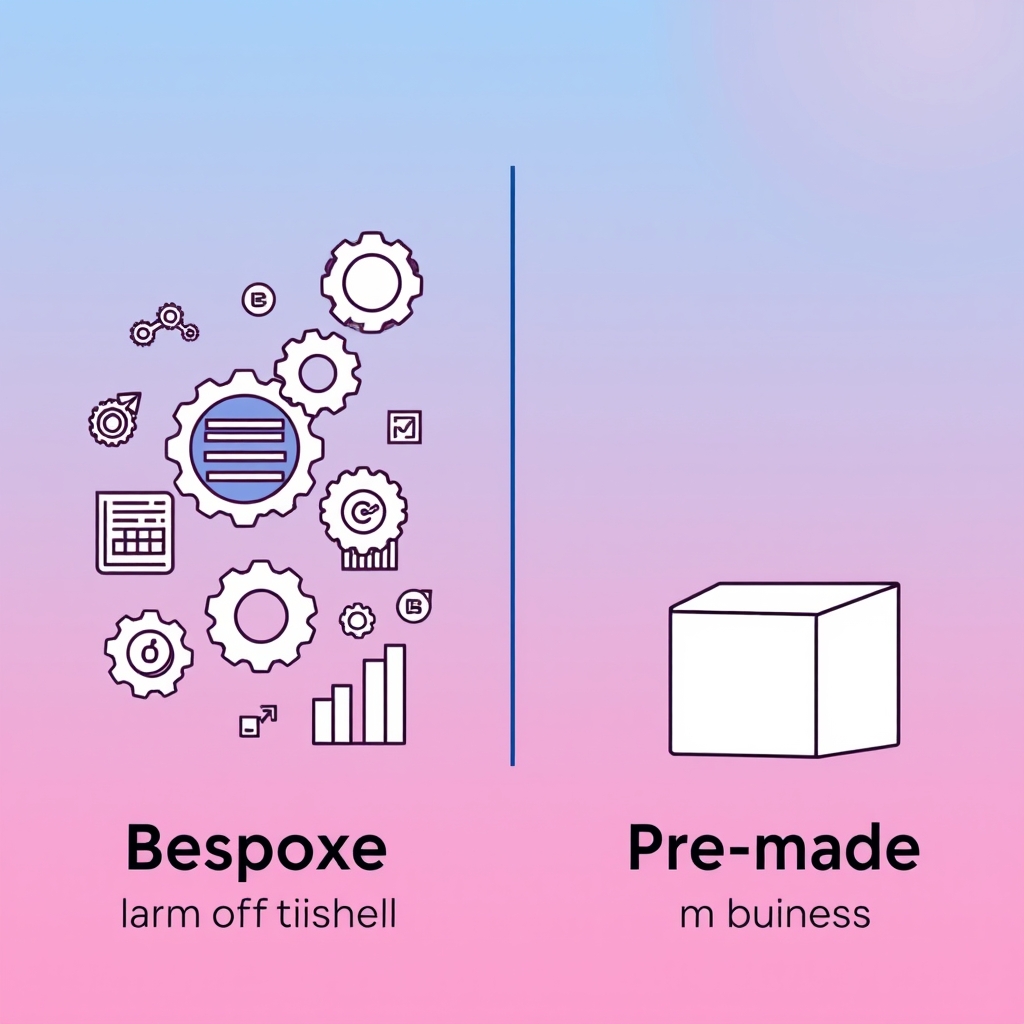
Off‑the‑shelf software is built to serve the widest possible audience, which means it solves common problems well but rarely fits the nuances of a growing business. Bespoke software, by contrast, is crafted around your exact workflows, compliance needs, and growth plans, turning those patchwork frustrations into a seamless engine.
In this article you’ll learn how the template trap inflates hidden costs, see a side‑by‑side comparison of short‑ and long‑term metrics, and discover practical triggers—and hybrid tactics—that tell you when it’s time to invest in a custom solution.
The sticker price of a subscription often looks attractive: $0 upfront, predictable monthly fees. But the real expense emerges when you start adding third‑party integrations, hiring consultants to build custom reports, or purchasing add‑on modules just to get basic functionality. Studies show that small businesses spend an average of 23% of their software budget on these workarounds.
Beyond direct fees, there’s the cost of lost time. Employees spend an average of 3.2 hours per week navigating between disconnected systems, translating to nearly $15,000 in annual wages for a ten‑person team. That time could be spent on sales, product development, or customer service instead of manual data shuffling.
Finally, scalability becomes a bottleneck. Off‑the‑shelf licenses may lock you into user tiers that force you to jump to a much pricier plan the moment you add a handful of users, while bespoke applications grow with you—adding new features or users rarely requires a costly plan change.
Side‑by‑Side: Bespoke vs Off‑the‑Shelf Metrics
To make the trade‑offs concrete, consider the following three‑year projection for a typical service‑based business with ten employees.
Metric
Off‑the‑Shelf (Typical Stack)
Bespoke Solution
Upfront Investment
$0 (subscription start)
$4,500 (development)
Ongoing Fees (yr)
$1,200
$300 (maintenance optional)
Scalability (users)
Limited by tier; +$800 per 5‑user jump
Linear; negligible extra cost
Integration Effort
High – custom scripts, middleware
Low – native APIs built in
Compliance Fit
Medium – often needs add‑ons
High – designed to spec
Time to Value
Immediate (but limited)
6‑8 weeks
Total 3‑Year Cost
$3,600
$5,100
At first glance the off‑the‑shelf option appears cheaper, but the table omits the hidden costs of integration, workaround tools, and lost productivity. When you factor in an average of $12,000 per year in efficiency losses from disjointed systems, the bespoke path actually yields a net saving of roughly $4,500 over three years—plus the intangible benefits of faster onboarding, happier staff, and a system that evolves with your strategy.
When to Make the Leap: Triggers, Hybrid Tactics, and Low‑Code Realities
So how do you know the moment has arrived? Three common signals tell growing businesses it’s time to look beyond templates: (1) you’re spending more than 10% of weekly payroll on manual data reconciliation, (2) compliance audits reveal gaps that off‑the‑shelf add‑ons can’t fully close, and (3) your sales or service teams are requesting features that vendors simply won’t prioritize.
A full custom build isn’t always the first step. Many firms adopt a hybrid approach: keep a proven off‑the‑shelf platform for core functions—say, WordPress for content—and layer a bespoke plugin that handles booking, invoicing, or customer‑portal logic. This way you preserve the low‑cost, well‑supported foundation while gaining the tail‑ored capabilities that drive growth.
Low‑code/no‑code tools have blurred the line further, enabling rapid prototyping of custom modules without deep programming expertise. However, they still hit limits when complex logic, high‑volume data processing, or stringent security is required. Smart businesses use low‑code for quick wins, then hand off the polished prototype to a development partner for production‑grade refinement—combining speed with robustness.
Turning Insight into Action: Your Roadmap to Custom Software Success
Armed with these insights, the next step is a structured evaluation. Begin with a workflow audit: map each repetitive task, note the tools you use, and quantify the time lost to switching between systems. Prioritize the processes that, if automated, would free up at least five hours per week per employee.
Then engage a development partner for a short discovery sprint—typically two weeks—to flesh out requirements, sketch a prototype, and outline a phased delivery plan. This approach limits upfront risk, lets you test assumptions early, and ensures the final product aligns with both technical feasibility and business goals.
If you’re ready to explore how a tailored application can transform your operations, BytesWeavers offers a free, no‑obligation consultation. Let’s turn your ideas into a robust digital product that scales as you grow.